
Magnetostrictive Displacement Sensor for Bridge Crane
Bridge cranes operate in demanding industrial environments where precise position feedback is essential for safe and efficient load handling. A magnetostrictive displacement sensor is an ideal solution for measuring the linear position of hoists, trolleys, and bridge travel. Its waveguide technology uses a current pulse and a permanent magnet to generate a torsional strain wave. The time between pulse launch and wave detection is converted into an absolute position value, so no reference run is required after power loss.
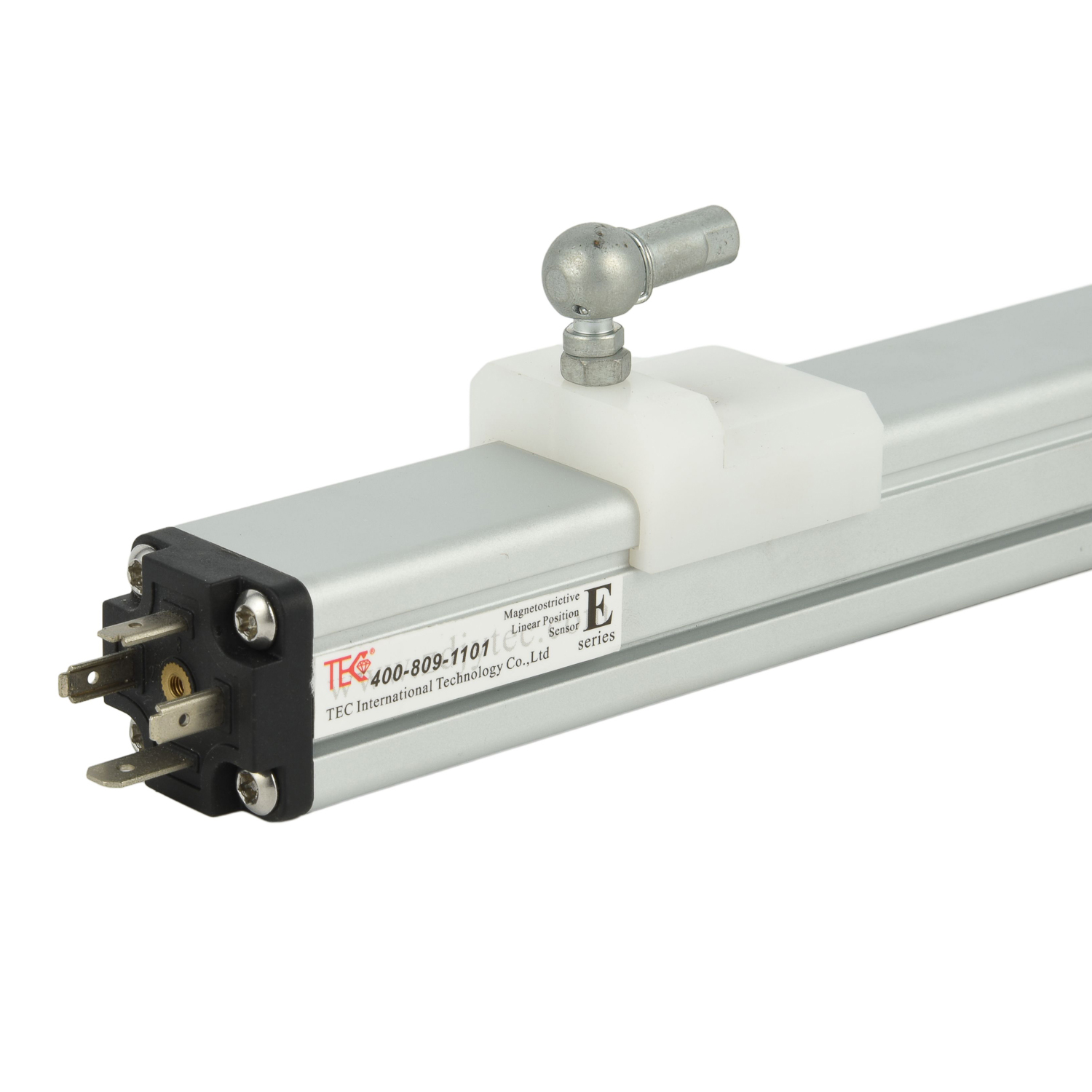
Unlike incremental encoders or potentiometers, magnetostrictive sensors offer non-contact operation, high repeatability, and long service life. They resist shock, vibration, dust, moisture, and temperature changes, which are common in steel mills, ports, and foundries. In bridge crane systems, they can monitor hoist height, trolley cross travel, and long travel position. This feedback supports smooth acceleration, precise load spotting, anti-sway control, and collision avoidance. It also helps prevent over-travel, overload, and unplanned downtime.
Many models provide analog outputs such as 4-20 mA or 0-10 V, plus SSI, CANopen, Profibus, and EtherCAT. Rugged housings with high IP ratings ensure reliable performance in outdoor and high-vibration crane applications. When selecting a sensor, consider stroke length, mounting style, output signal, resolution, and protection. With a magnetostrictive displacement sensor, bridge cranes achieve faster cycles, safer operation, and smarter automation.
 Grain and Oil Storage Tank Int
 Mixing Station Rod-type Linear
 Shield Tunneling Flange-mounte
 Injection Molding Machine Non-